AUTHORS

Jeremy Zeman
Managing Director, Head of the Consumer
& Commercial Banking Practice | True Search

Jonathan Pomeranz
Managing Director, Head of the CEO, Board, and
FinTech & Financial Services Practices | True Search
The talent boundaries separating banking, fintech, payments, digital assets, and embedded finance are collapsing. At True’s Financial Services Practice, we are seeing executives moving at a dizzying pace across ecosystems that once operated as distinct talent markets.
The finserv convergence starts with competition
Fintech companies have spent the past decade disintermediating, deconstructuring and reassembling what it means to offer banking services. Unencumbered by legacy systems and embracing advanced technology faster than traditional banks, these companies have reimagined and brought to market innovative lending, deposit and payment products, and customer-centric digital experiences.
In response, banks have been forced to shift how they think about talent and leadership, leading to a structural and cultural reset for banking. Building a digital banking platform or integrating embedded finance require organizational transformations with leaders who have experience across technology, product, and financial services. Long tenure inside a single institution rarely produces these types of leaders.
At the same time, mature fintechs are pursuing bank charters and deepening their partnerships with the institutions they once sought to challenge.
Three migration patterns are reshaping the finserv talent market:
Banks searching outside traditional pipelines for digital leaders
Established financial institutions are increasingly looking to overhaul their customer and product experiences. They’re seeking executives who understand how digital-native platforms are built and can bring that operating model into a regulated, scaled environment. In fact, 57% of True’s banking placements over the last five years had fintech backgrounds.
57% of True’s banking placements over the last five years had fintech backgrounds.
Bank executives moving to fintech boards
Fintech companies are actively seeking senior banking leaders for their boards, and banking leaders are actively pursuing these seats. For bank executives, fintech boards offer proximity to digital-native operating models, leaner product cycles, and more aggressive AI deployment than most traditional institutions can currently match.
Fintechs recruiting banking operators for credibility and partnership
As fintechs build toward bank charters and pursue institutional partnerships, they need executives who understand how traditional financial institutions think, decide, and operate at scale. 26% of True’s fintech placements over the last five years had experience at traditional financial institutions.
26% of True’s fintech placements over the last five years had experience at traditional financial institutions.
The rising profile of the hybrid executive
This year, True placed a candidate whose career spans banking, fintech, and payments into a Big Five banking institution, and a former bank CEO onto the board of a high-growth fintech. Both moves reflect growing demand for leaders who have operated across at least two financial services ecosystems rather than built depth in just one.
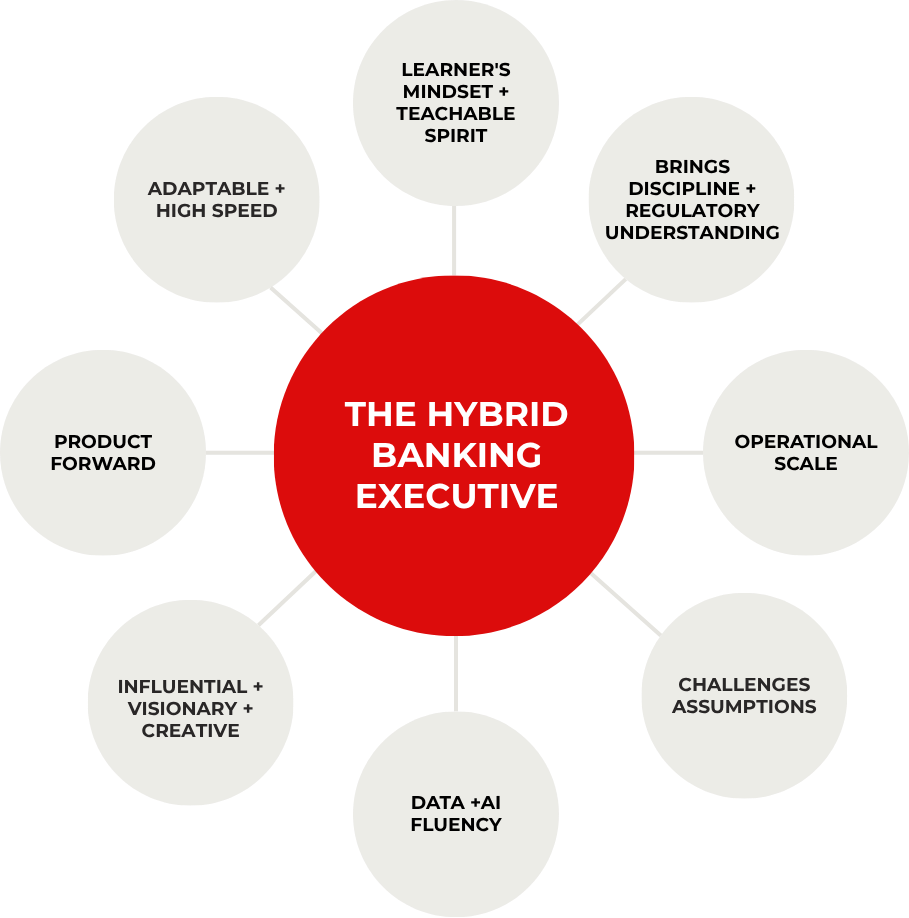
This type of hybrid executive brings the discipline, regulatory understanding, and operational scale of traditional banking alongside experience in faster, more product-forward environments. They are adaptable across different operating models and have the capacity to evolve as new ecosystems take shape. Data and AI fluency are increasingly essential, alongside a learner’s mindset and teachable spirit. These leaders challenge assumptions and bring the influence, vision, and creativity needed to navigate change.
Rethinking the financial services talent model
At True, we help clients rethink how they scope searches, evaluate candidates, and build pipelines to identify leaders whose experience, capabilities, and leadership style align with what the business needs right now.
Rewrite the search brief before the search begins
For roles at the intersection of digital transformation, payments, or AI-driven strategy, institutions should examine the assumptions behind their criteria. Does a requirement for deep conventional banking experience reflect a genuine operational need, or simply the default?
Build cross-ecosystem succession pipelines
Non-traditional candidates should be part of the pipeline before a leadership transition is imminent. Consistently mapping talent across banking, fintech, payments, and digital assets creates a broader pool when critical roles open up.
Assess AI fluency as a criterion
For many institutions, there is a gap between what they seek in candidates and how they assess it during a search. A modern and forward-looking tool like the True AI Capability Index℠ can evaluate both AI fluency and potential leadership agility in executive candidates, softening the emphasis on past experience.
Apply the same lens to board composition
The convergence between banking and fintech extends to the boardroom. Directors with fintech operating experience, payments expertise, or AI fluency can bring real-time perspective to the strategic decisions banks face. As bank executives join fintech boards, the value increasingly runs in both directions.