CEO turnover is at a post-financial crisis high, with roughly one in nine of the largest public companies replacing their CEO last year. Organizations are facing a “perfect storm” with AI disruption, geopolitical risk, valuation compression, and shifting investor demands. Leadership changes now signal a structural market reset, not isolated failures, as the definition of effective leadership rapidly evolves. At True’s CEO Practice, we’re seeing companies increasingly hiring younger, first-time CEOs out of necessity, not just by choice.
A CEO Supply–Demand Imbalance Is Reshaping the Market
Securing the traditional “safe hire” of a repeat CEO is highly challenging in today’s market as boards search for leaders who can reposition businesses, lead transformation, and navigate a level of technological change that few industries have experienced before.
Many proven CEOs are opting out of the market, preferring board positions or operating partner roles, taking a break after leading through multiple volatile cycles, or waiting for market clarity before committing to a new role. Some long-term CEOs are also stepping down because of a “lack of will” to learn AI. Those who do engage often favor stable or high-growth environments and look for opportunities that are larger than their previous roles.
Internal Succession Is Under Fire
High market demand for CEOs is pulling rising executives out of organizations before they can step into the top role. These leaders are leaving for external CEO opportunities rather than waiting for promotion. This weakens internal bench strength and compresses succession timelines, leaving fewer “ready-now” internal candidates in the pipeline. Succession planning, therefore, needs to be a well-thought-out retention strategy today.
Pressure from activist investors on public companies is also driving an increase in public company CEO searches. Boards are proactively choosing to replace leaders who fail to show ROI on tech investments. Traditional CEOs are more likely to have an “AI maturity gap” and boards increasingly choose external candidates over long-term internal successors to preempt activists. A company veteran can signal “more of the same,” while a fresh leader, often from a different industry or discipline, suggests a willingness to pivot.
The “SaaSpocalypse” Further Shrinks the CEO Pipeline
AI-driven product changes, investor pressure for combined profitability and growth, compressing valuations, and macroeconomic volatility have created significant pressure on SaaS businesses. This climate demands new leadership, but many senior executives are choosing to wait for the market to stabilize.
Companies, however, can’t wait. They must hire leaders at the exact moment when candidates have become more selective and cautious.
What this means for CEO hiring:
- Past success in growth environments no longer predicts success in today’s market.
- Boards must evaluate candidates on their ability to operate through compression, not just expansion.
- CEO hiring processes must assess how leaders make decisions under uncertainty, not just how they have executed in stable conditions.
Private Equity Faces a Structural Talent Constraint
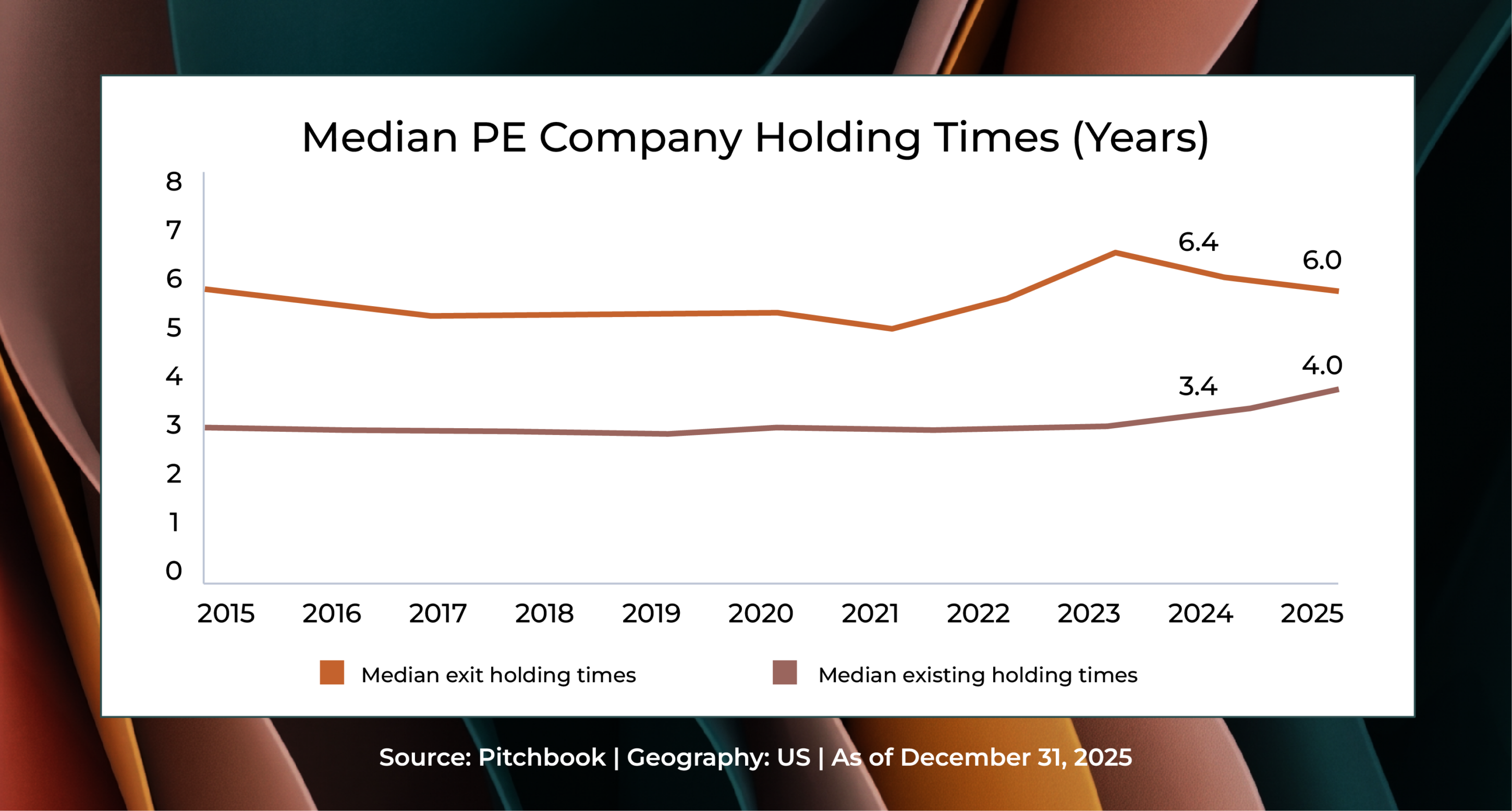
Longer PE holding periods are limiting the executive talent pipeline, as fewer exits reduces the pool of executives with prior PE-backed transformation experience. The traditional step-up path of hiring a CRO, CPO, or COO who has already been through a successful transaction is thinning.
This forces PE firms to redefine both where they find talent and what “readiness” means. They are now broadening their search beyond the conventional pool and considering divisional leaders from large public companies, technology / product executives, and operators with transformation experience outside traditional PE.
What PE investors should do now:
- Reassess whether prior PE experience is a true requirement or a preference.
- Evaluate candidates based on transformation capability, not transaction history.
- Build leadership teams that compensate for gaps rather than expecting one “complete” CEO.
The Next Generation of CEOs Come from Unconventional Backgrounds
As the traditional pipeline tightens, a new generation of CEOs is emerging. Boards prioritize candidates who:
- Understand how AI reshapes products, operations, and customer experience
- Are able to strengthen the feedback loop between Product and GTM
- Can translate innovation into scalable business value across the organization
This has expanded the CEO candidate pool to include first-time leaders from roles such as Chief Product Officer, Chief Technology Officer, Chief Revenue Officer, and divisional general managers.
The New CEO Trade-Offs
These leaders often bring what companies need most, but rarely check all the boxes. Novice CEOs often show greater self-awareness and willingness to seek board help, address their own areas of improvement, and aggressively reinvent operations, unlike many of their veteran counterparts.
However, first-time CEOs lack the broad experience boards typically prefer. For example, a product-centric leader may have vision but limited go-to-market skills, or a revenue leader may excel commercially but lack product or engineering fluency. Many haven’t managed a full P&L or led an entire organization.
Proven CEOs with product or engineering expertise are rare, on the other hand, because the path to CEO traditionally favors leaders from operational, financial, or GTM backgrounds. Therefore, organizations need to be intentional about what trade-offs they make and why.
How to De-Risk First-Time CEOs
First-time CEOs can succeed with the right support structure. While they’re agile, these leaders face steep learning curves. At True, we consistently see step-up CEOs struggle with:
- Building leadership teams that offset their gaps
- Navigating the board dynamic for the first time
- Balancing functional depth with enterprise-level decision-making
To increase the odds of success for first-time CEOs, companies must:
- Build complementary leadership teams intentionally, especially across product, go-to-market, and finance.
- Design onboarding around the new CEO’s areas of improvement.
- Increase early board engagement while maintaining clear operating boundaries.
The CEO-CFO Partnership Has Become a Strategic Lever
As the CEO role transforms, it’s driving similar shifts in the role of the Chief Financial Officer. Today’s CFO must be a strategic partner to the CEO, steering a company through volatile capital strategies, valuation pressure, operational restructuring, and AI investments.
We increasingly see organizations look for complementary leadership pairs where the CEO drives vision, transformation, and innovation, and the CFO provides financial discipline and market credibility. Together, they jointly navigate both disruption and accountability. In many cases, the success of a first-time CEO depends less on the individual and more on the strength of this partnership.
Leadership Assessment Must Evolve
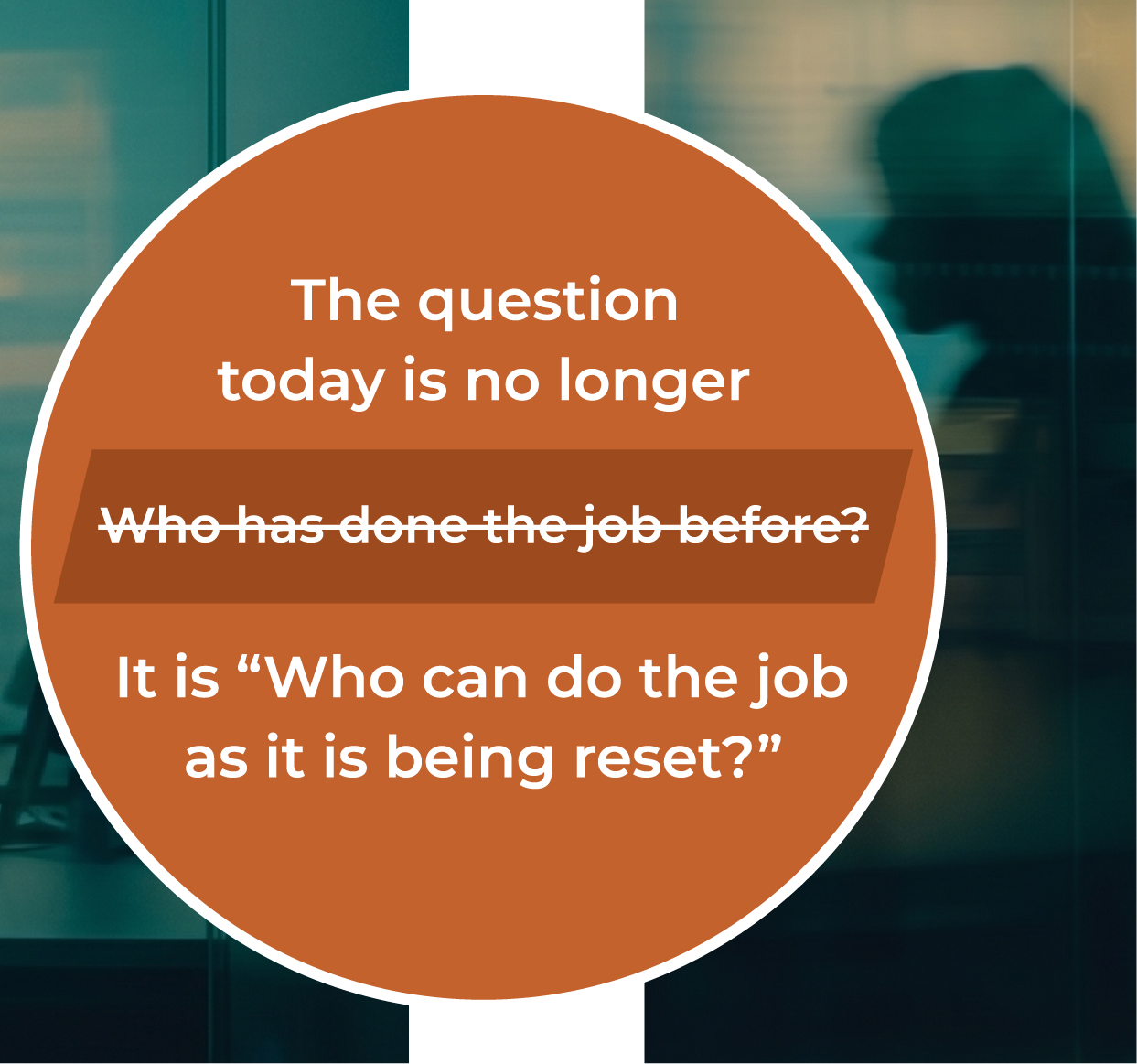
The most significant shift may be how organizations evaluate leadership. While traditional criteria like prior CEO experience, P&L ownership, and industry tenure are still relevant, they reflect a time of stable models and linear career paths.
This requires a forward-looking assessment model where organizations must become comfortable evaluating nontraditional career paths, executives earlier in their career, and CEOs who have never been in the role before.
What to Assess Now:
- Has this leader driven meaningful change across functions?
- Can they reposition a business, not just operate it?
- Do they have the ability to hire for these trends themselves?
- How do they frame their company’s / division’s AI relationship: tool, transformation, or threat?
- What is their comfort-level with probabilistic decision-making under uncertainty?
- How fast do they revise prior models when the environment shifts?
- Do they understand how technology shapes strategy and operations?
- Can they translate innovation into business outcomes?
- What is their experience with prior cutting edge tech trends?
- Have they personally engaged with AI tools or have they delegated it entirely?
- How quickly have they expanded beyond their original domain?
- Do they demonstrate the ability to grow into the role?
The CEO Role Is Redefining Itself in Real Time
No single blueprint defines the ideal CEO today. The leadership model for the next decade is still taking shape.
Future CEOs will likely be more hands-on, technically fluent, and directly involved in product and engineering. This is a departure from traditional, high-level strategy, especially in large firms. As AI restructures industries, leaders who understand the technology and can apply it to business problems will have the edge.
Organizations need to rethink how leadership is identified, evaluated, and developed. Those that broaden candidate pools and prioritize adaptability will be the ones that make better leadership decisions.
AUTHORS

Evan Grossman
Managing Director, Head of the CEO and Board Practices
.

Jonathan Pomeranz
Managing Director, Head of the CEO, Board, and Financial Services Practices
.

Matt Goldstein
Managing Director, Head of the Finance and Private Equity Practices
For media inquiries, contact Jillian Ruggieri