As the conversation surrounding AI shifts from adoption to reorganisation, we are in the midst of an Industrial Revolution for white-collar work. True’s executive search experts in the Go-to-Market (GTM) Practice interviewed leaders across Sales, Customer Success, Marketing, and RevOps to map how this transformation is impacting today’s org chart. Here’s how AI is redefining every role on your Go-to-Market team.
1. Sales:
From Reps to Revenue Orchestrators
AI is revamping sales beyond just speeding up manual tasks. As zero-touch CRMs and automated research handle the administrative burden, the focus of talent management is shifting from activity metrics to strategic capability.
The Consolidation of the BDR/SDR Role
The tech is most immediately rewiring the entry-level Business Development Representative (BDR) role. We are moving towards a model where a single Sales Development Representative (SDR), aided by AI agents and refined prompting skills, can achieve the output of three traditional reps. This allows for leaner, higher-skilled teams, but it eliminates the traditional training ground for future account executives. Leaders must now rethink how they identify and groom junior talent as AI automates the entry-level ‘grind.’
The Premium on Human Judgment
Human connection becomes the primary differentiator when every competitor uses the same AI models to write homogenised emails. The role of the account executive then shifts from a volume generator to a revenue orchestrator. The talent profile required for this role prioritises high-EQ skills like navigating nuance, building trust, and exercising judgment in complex negotiations.
2. Customer Success:
Transition to Growth Engines
Delegating binary tasks like ticket deflection, transcription, and usage monitoring to AI agents is speeding up the long-awaited transformation of Customer Success (CS) from a reactive support function to a proactive growth engine.
Redefining Capacity and Ratios
Automating the ‘detect and alert’ phase of customer health dramatically increases the bandwidth of a single Customer Success Manager (CSM). For leadership, this means the focus is on scaling the impact of existing talent. As AI reduces the administrative burden, it also adjusts the needs for junior relationship manager roles. The bar is rising for CSMs who possess a hybrid skill set: high technical literacy to work with AI tools, combined with the commercial instincts to identify upsells.
One CS leader shared a concrete example of this commercial instinct in action. After AI detected new logins from a dormant client, a CSM re-engaged the account and closed a significant upsell. Advanced AI engines also analyse call transcripts in real time to provide CSMs with live suggestions and insights. In this new dynamic, the role of the human shifts. Professionals now dedicate their time to checking accuracy, applying empathy, and bringing the critical thinking that AI cannot replicate.

3. Marketing:
Winning in the Era of Generative AI
Marketing is the most nuanced, creative GTM function, yet it has become the most prolific user of binary, data-driven AI tools. As teams integrate agents for competitive intelligence and content generation, the mandate for marketing talent is shifting from ‘output’ to ‘outcome.’
From Creation to Curation
As AI generates high-quantity drafts and landing pages instantly, managers now value a marketer’s ability to discern quality above their technical skills. This enables significantly leaner teams, but it raises the bar for talent. Organizations now need strategists who can curate and refine AI outputs rather than copywriters who start from scratch. As AI automates the ‘grunt work’ like drafting, researching, and testing, leaders must actively redesign junior roles to focus on judgment and strategy earlier in their careers.
The Shift from SEO to GEO
A significant change is the transition from Search Engine Optimisation (SEO) to Generative Engine Optimisation (GEO). As customers bypass Google links for direct answers from LLMs, the technical skills required to win visibility are changing. We are moving away from technical keyword manipulation to brand authorities who understand how to structure content so AI models cite it as a source.
4. Revenue Operations:
The Architects of Intelligence
As the function responsible for integrating strategy, process, and data, RevOps has become the natural command center for AI adoption. The directive from leadership is to move beyond maintaining systems to actively designing the framework that allows Sales, CS, and Marketing to leverage AI effectively.
From Maintenance to Next Best Action
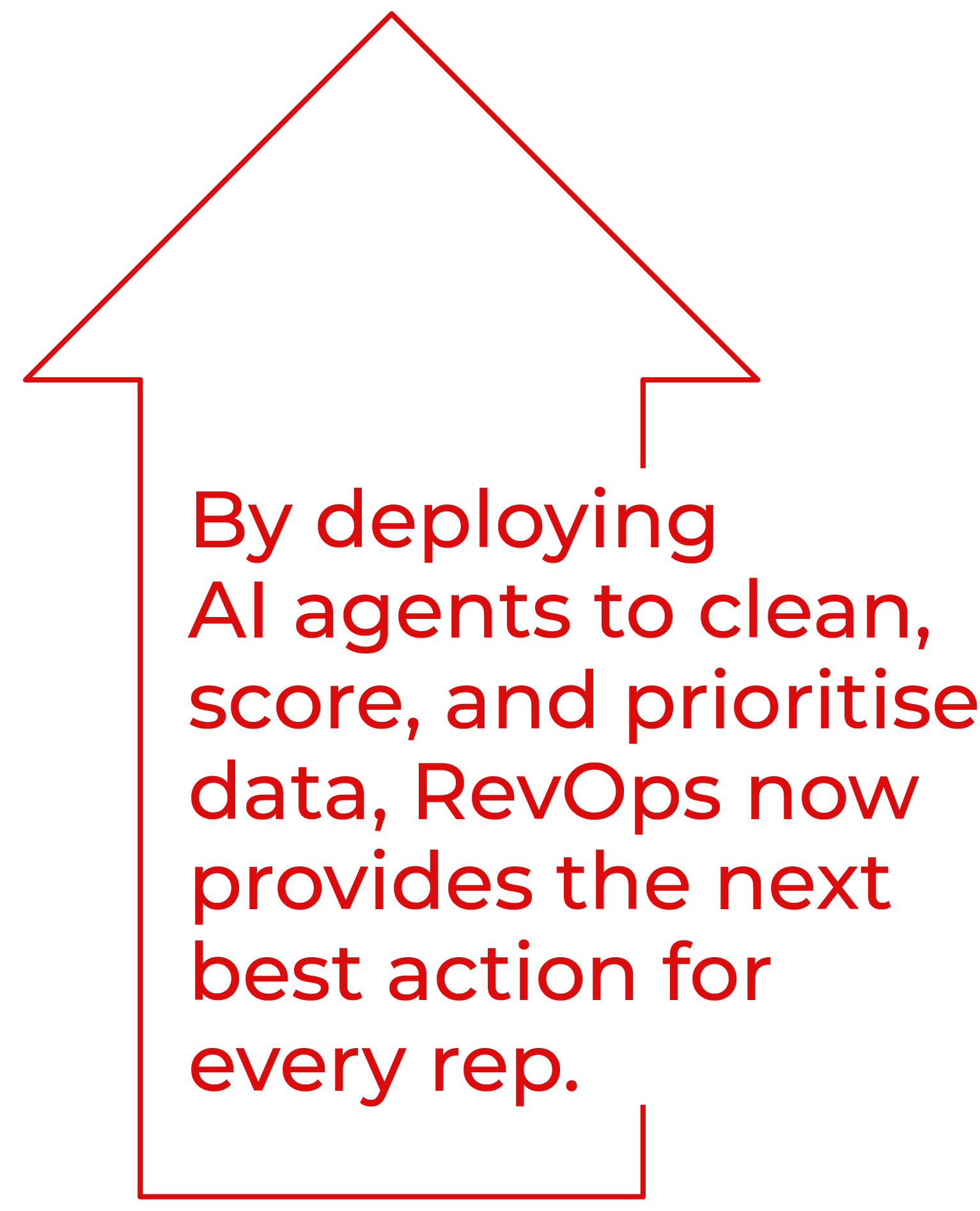
In the past, RevOps managed static lists. Today, they manage dynamic intelligence, which shifts the operational focus from data entry to data enrichment. By deploying AI agents to clean, score, and prioritise data, RevOps now provides the next best action for every rep. This elevates the team from a back-office support function to a strategic partner that directly influences revenue conversion.
The Rise of the GTM Engineer
Companies are beginning to create dedicated AI and Productivity sub-teams within RevOps made up of ‘builders’ capable of coding, integrating complex LLMs, and architecting a scalable revenue engine. This has given rise to the GTM Engineer, a hybrid role that combines traditional operations experience with technical engineering skills.
From Linear to Leverage-Based Growth
We are shifting from a Growth Hacker mindset to a disciplined, systems-led approach, characterized by a leverage-based growth model. Unlike the legacy model where revenue was tied to hiring, the AI era allows organizations to scale output without a corresponding spike in payroll by building automated revenue stacks.
The ‘Builder’ Mandate
The goal for talent acquisition now is to find the builders who can construct the ‘machinery’ of sales and marketing. By integrating low-code platforms with AI agents, these professionals ensure that data flows seamlessly across the GTM function. In this environment, the ultimate competitive advantage is the sophistication of the engine they build, not the size of the team.

The New GTM Talent Playbook
The profile of a top performer now includes AI literacy as a basic requirement in addition to other criteria like curiosity, grit, and emotional intelligence.
Assessing for Prompt Literacy
In this new landscape, curiosity is best measured by a candidate’s willingness to experiment. Hiring managers now screen for prompt literacy, the practical ability to frame queries that extract value from LLMs. As AI commoditises basic outputs, the premium shifts to the human ability to inject empathy and judgment into the workflow. The ideal candidate is no longer just a ‘doer,’ but an editor and an orchestrator.
The ‘AI Brand’ Gap
The market for this talent is fiercely competitive and the biggest barrier to hiring AI-fluent professionals is often the company’s own lack of maturity. High-performing candidates want to join organisations where they can apply their skills, not fight for permission to use them. If a company cannot articulate a clear AI narrative demonstrated through deep adoption or a modern tech stack, they risk losing the next generation of leaders to more future-ready competitors.
Conclusion
The Industrial Revolution did not eliminate the need for labour. It shifted the value of labour from physical strength to machine operation. Similarly, AI is automating the repetitive, binary tasks that once consumed the modern workday, which elevates the standard for human contribution. For leaders, the path forward is not to replace people, but to build a culture where AI proficiency meets human judgment. The winners of this era will not be the companies with the best algorithms, but the companies with the best talent orchestrating them.
AUTHORS

Ben Paterson
Managing Director, Head of the Go-to-Market Practice
.

Yana Skobeleva
Principal
.

David Winch
Managing Director, Head of the Enterprise Software & Services and Go-to-Market Practices
.

Sofia Offord
Senior Associate
For media inquiries, contact Jillian Ruggieri